

By Ian Brouckaert
LE&A GmbH · November 2026 · 6 min read
A new finance analyst starts on Monday. Her laptop is ready. Her accounts are not. She spends her first days borrowing a colleague's screen while someone chases a ticket.
Down the corridor, a manager who moved from procurement to finance can still approve purchase orders. Nobody removed the old access, because nobody asked.
Meanwhile, the company may still be paying for software licences assigned to people who have already left.
A joiner, a mover and a leaver. In each case, the change had already been recorded in SAP. It just didn't reach the systems that grant and remove access in time.
In our experience, the cause is rarely a lack of care. The trouble sits in the gap between the system that records a change and the systems that have to act on it.
All three events carry real consequences, and in our experience they matter equally.
The CIO sees a control problem. The CFO sees a cost problem. The CHRO sees a question of data responsibility. Each owns part of the lifecycle, and often nobody owns all of it.
The causes are structural. They are rarely a matter of individual mistakes.
HR, IT and identity teams each keep their own record of the same person. HR manages the employee in SAP HCM (SAP ERP Human Capital Management). IT manages the user account in Active Directory or Microsoft Entra ID, Microsoft's cloud identity service. Each team has its own processes, timings and definitions.
Every lifecycle event touches several of these at once:
Real organisations are messier than three rows. There are rehires, long-term leave and returns, contractors, and country payroll running alongside a global template, which is the shared core design rolled out across all countries. The process has to handle each of these as it really happens.
Many HR-to-IT interfaces were built quickly to keep the business running: a nightly file, a spreadsheet, a ticket queue. Those were sensible decisions at the time. What they rarely had was a single design behind them, with clear ownership.
In our view, good practice comes down to four principles.
1. One authoritative source. SAP workforce data defines who the person is, where they sit in the organisation and when that changes. In SAP HCM these facts are held in infotypes, the groups SAP uses to store employee data, such as personnel actions and organisational assignment. Identity systems should take the facts from there rather than re-enter them.
2. A clear ownership boundary. HR owns what the data means. IT and the identity platform own accounts, groups, roles, licences and passwords. Once that line is agreed and written down, it becomes much clearer who should act on each change.
3. Controls built into the flow. Reporting lines should come from the SAP organisational structure rather than being typed in by hand. A record that fails validation should be rejected and reported, never quietly corrected. Only the data that identity management needs should leave HR. Payroll and other sensitive HR data stays in SAP.
4. Governed over time. Every exception has a named owner and is reviewed. When the organisation changes, the lifecycle rules change with it through a controlled process.
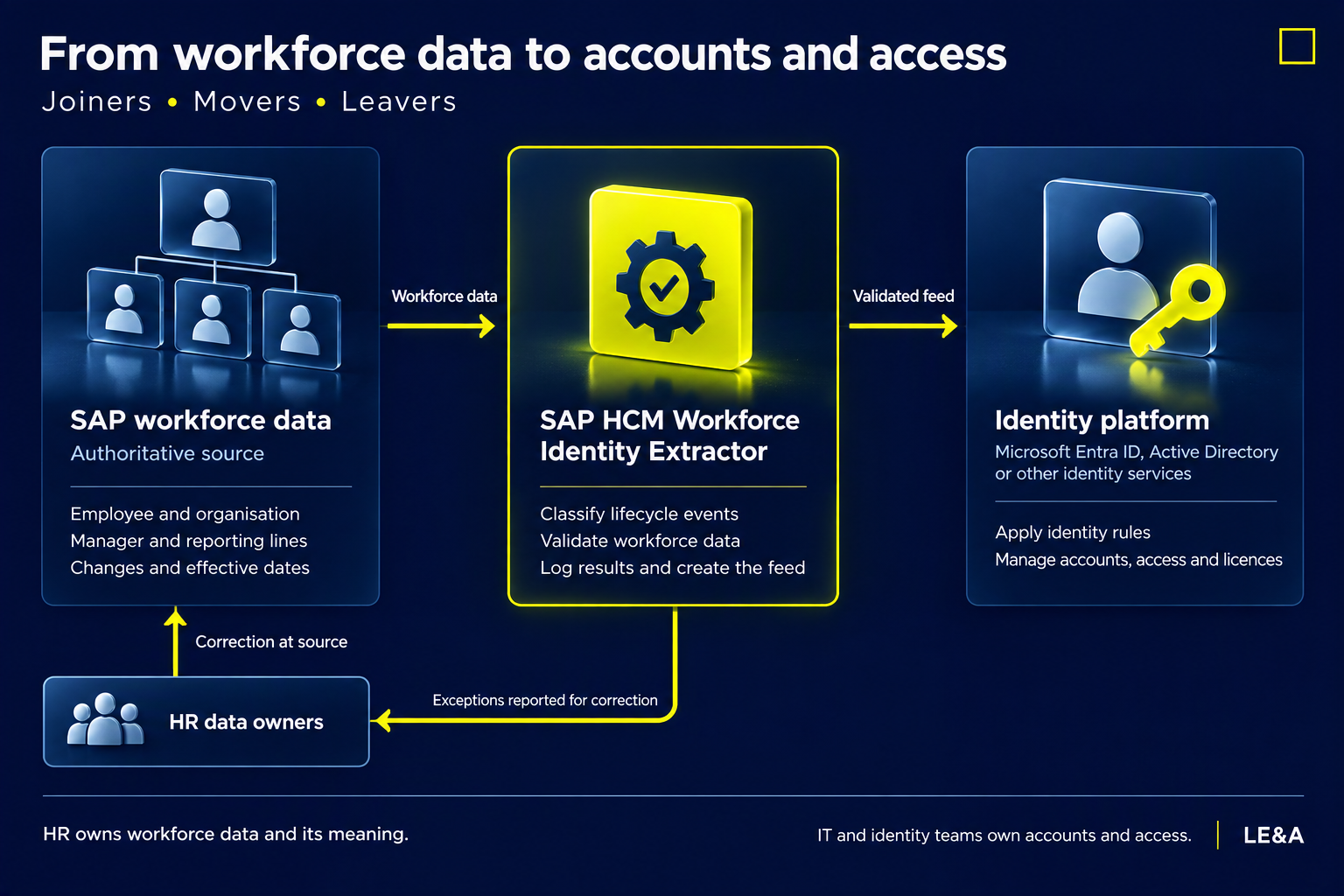
We work in four steps: Understand, Define, Connect and Govern.
First, we look at how joiner, mover and leaver events are handled today and where they break down. Then we define the lifecycle architecture: the authoritative data, the identity key that links each person to their account, the lifecycle rules and the ownership boundary. Next, we connect SAP workforce data to Microsoft Entra ID, Active Directory and other identity services, working with your identity team. Finally, we set up the validation rules and lifecycle controls that support governance over time.
For the connection, we use one of our project accelerators, the SAP HCM Workforce Identity Extractor. This reusable framework:
It has already been run against real HR data. Projects start from an existing, tested framework, so attention goes to the decisions that are specific to each organisation. We configure it to each organisation's scope, mappings and rules, and keep custom development to what is actually needed.
Find out more about our Employee-to-Identity Architecture solution.
If someone leaves your organisation on Friday, who knows by Monday, and how?
If the answer isn't clear, that's the place to start. Book a discovery call with LE&A, or email us at office@le-and-a.com.
AI tools were used to support the preparation and editing of this article. The content was reviewed and approved by the named author.